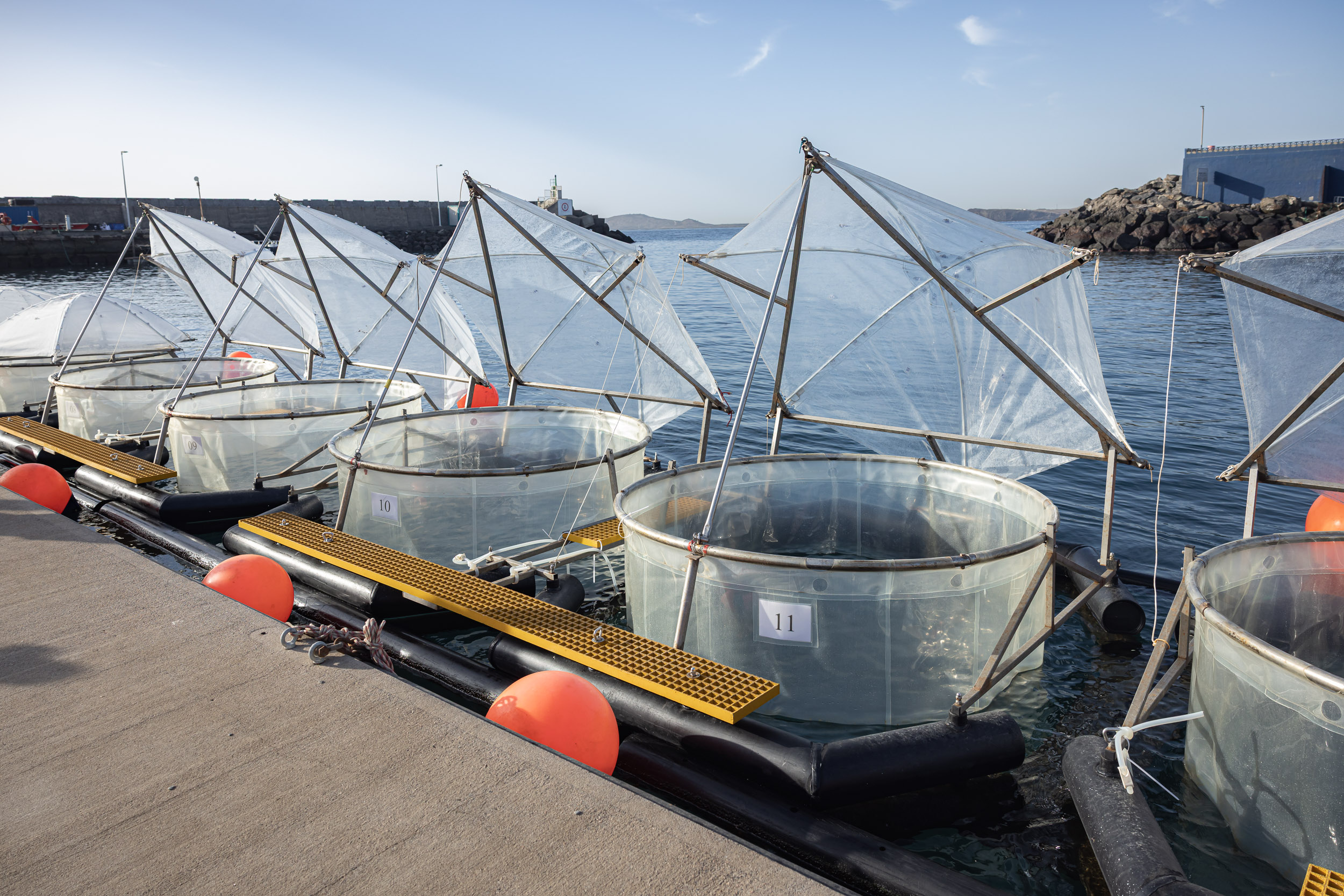
The test site of the Oceanic Platform of the Canary Islands (PLOCAN) is now hosting the new floating structure “Don”, a prototype designed to generate clean energy from the ocean on a continuous basis and to operate safely even during storms and hurricanes.
The device, recently installed off the coast of Telde, is designed to reinforce energy security in island regions affected by tropical storms and, more generally, those more exposed to climate risks and which currently depend mainly on fossil fuels for energy production.
“Don”, the support structure framed within the PLOTEC project and funded by the European Union’s Horizon Europe programme, consists of a cylindrical hull, a cold-water intake pipe and a dedicated connection point. It operates on Ocean Thermal Energy Conversion (OTEC), which uses the temperature difference between warm surface water and cold deep water to drive a thermodynamic cycle that can supply round-the-clock baseload power to island communities exposed to climate risks.
As the ocean surface remains warm throughout the year in tropical regions, OTEC can provide continuous electricity, making it a sustainable energy option for tropical islands.
This is the first long-term offshore operation of an OTEC platform in decades, following demonstrations carried out in Hawaii in the late 1970s and early 1980s. The installation of “Don” comes at a time when resilience and energy security are once again high on the international agenda, with the United Nations Climate Change Conference (COP30) taking place since yesterday in Belém, Brazil, and the recent passage of the devastating Hurricane Melissa through the Caribbean.
“The current climate context underlines the relevance of the project. The PLOTEC project seeks to accelerate the renewable energy transition in island regions facing extreme phenomena,” explained Nalu Franco, project manager at PLOCAN.
“With the advances of the PLOTEC project, with storm-resilient structures, OTEC stands out as a robust solution to power outages and rapid recovery in extreme tropical climates, addressing energy needs and supporting a sustainable future for island communities – all by harnessing their most abundant resource, the ocean,” she added.

After the deployment of the prototype’s cylindrical hull at PLOCAN’s test site, the next phase of work will consist of installing and connecting the cold-water pipe that will complete the full structural testing system in the Atlantic Ocean environment.
After the deployment of the prototype’s cylindrical hull at PLOCAN’s test site, the next phase of work will consist of installing and connecting the cold-water pipe that will complete the full structural testing system in the Atlantic Ocean environment.
The tests will continue over the coming months, and performance data are expected to be obtained in early 2026. If the results are positive, they will support the design of large-scale OTEC systems capable of powering entire island grids and offshore facilities.
Alongside PLOCAN, the consortium driving this project is made up of Global OTEC (United Kingdom), Cleantech Engineering Limited (United Kingdom), WavEC Offshore Renewables (Portugal), Quality Culture (Italy), Agru Kunststofftechnik Gesellschaft m.b.H. (Austria) and the School of Engineering, Computing and Mathematics at the University of Plymouth (United Kingdom).
“This is more than a test of the core technology, which has already been proven to work: it is a demonstration of resilience,” said Dan Grech, founder and CEO of Global OTEC. “If we can demonstrate that OTEC platforms can operate safely and continuously under extreme weather conditions, we open a new chapter for clean baseload energy in the regions that need it most.”
The structure was named “Don” in honour of Don Lennard, an engineer who devoted his career to the development of OTEC. The results obtained during these months of testing will contribute knowledge to marine engineering, modelling and the development of materials for offshore applications.