Scientists from the GEOMAR Helmholtz Centre for Ocean Research Kiel, together with several international institutions and in collaboration with the Oceanic Platform of the Canary Islands (PLOCAN), have deployed twelve marine laboratories to study the potential use of concrete waste for ocean climate protection.
The experiment was presented at the Taliarte quay, in Telde, by Professor Dr Kai Schulz of Southern Cross University, Australia, and GEOMAR; Silvana Neves, Head of PLOCAN’s Ocean Observation and Marine Environmental Restoration research line (LIN-OR); and Professor Dr Javier Arístegui of the University of Las Palmas de Gran Canaria (ULPGC), at a press briefing attended by the German Consul in the Canary Islands, Ralf Reuter.
In twelve mesocosms — giant floating test tubes isolated from the surrounding seawater — the scientists are studying the possibility of using concrete waste to increase seawater alkalinity and understand its effects on marine life. Ocean Alkalinity Enhancement (OAE) limits the natural rock weathering process and can increase the ocean’s capacity to absorb carbon dioxide from the atmosphere, as well as reduce seawater acidification.
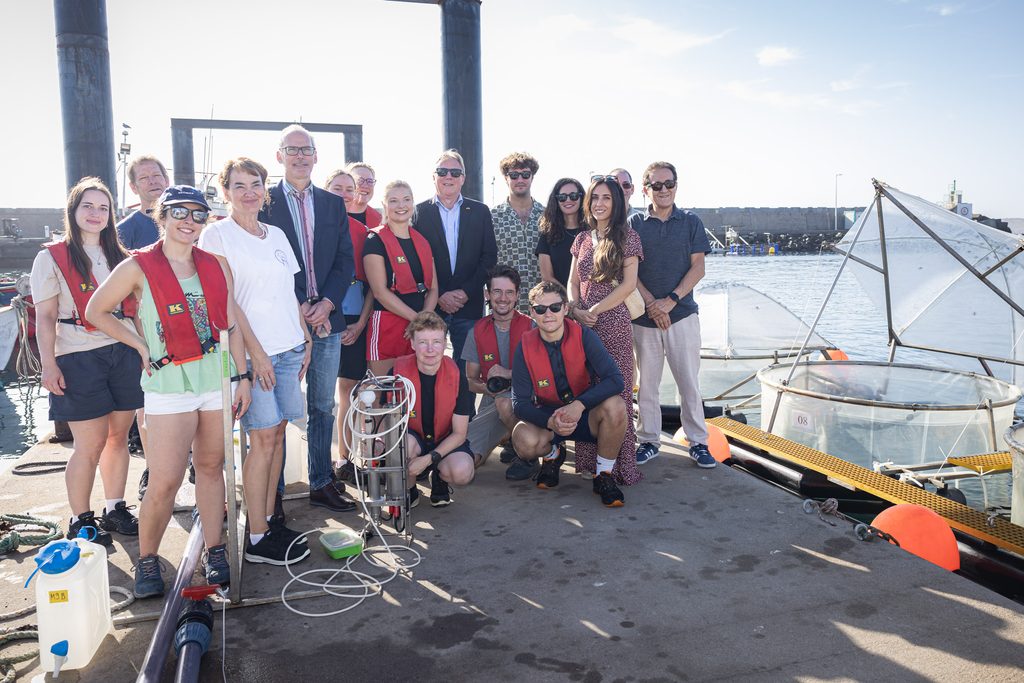
“This year’s experiment involves comparing a liquid source of alkalinity with ground concrete rubble and assessing how well both substances are tolerated in the marine environment,” explains Professor Emeritus Dr Ulf Riebesell, marine biologist at GEOMAR and co-leader of the experiment. The experiment forms part of the international research project OceanAlkAlign, which aims to standardise measurement and assessment methods for Ocean Alkalinity Enhancement, thereby creating a solid basis for future decisions.
The experiment is being carried out in the waters off the Taliarte quay, where the mesocosms have been deployed and are being filled and monitored throughout the seven-week trial, alongside PLOCAN’s facilities — a long-standing research partner of GEOMAR.
Why we need carbon dioxide removal
The idea of adding more alkalinity to the sea is part of a wider context. Since the start of industrialisation, the carbon dioxide content of the atmosphere has increased considerably; a significant proportion of the gas dissolves in the ocean, altering its chemistry. The result is progressive acidification, which can place particular pressure on organisms that form calcareous structures, such as mussels or corals. At the same time, the additional carbon dioxide is driving global warming.
According to many current scenarios, emissions reductions alone will not be enough to meet the goals of the Paris Agreement. As a result, methods for actively removing carbon dioxide are gaining prominence. Ocean Alkalinity Enhancement is considered a high-potential option, provided it can be implemented effectively and in an environmentally responsible manner.