NEWS

Annual BlueMissionAA meeting to drive restoration of the Atlantic and Arctic oceans
The BlueMissionAA project, funded by the European Union, aims to develop a shared vision and a road map for the ecological restoration of the Atlantic and Arctic oceans. It also encourages citizen participation and innovation in this field. The project had its annual meeting in Cascais, Portugal, with the involvement of PLOCAN. The opening of

Seasonal ocean-observations program in the Canary Islands: EMSO-ESTOC-RAPROCAN
PLOCAN, the Spanish Institute of Oceanography (IEO) and the University of Las Palmas de Gran Canaria (ULPGC) continue to promote and strengthen their collaboration in the ocean-observing strategy in the Canary Islands through the seasonal program based on glider missions at the Time-Series station ESTOC (deep node of the PLOCAN Integrated Observatory) and Deep Radial

Marine Science with PLOCAN at the Canary Islands Science and Innovation Weeks 2023
PLOCAN’s mission and its contribution to achieving the Sustainable Development Goals was the focus of the participation of the Singular Scientific and Technical Infrastructure in the Canary Islands Science and Innovation Weeks 2023. Science plays a crucial role in maintaining a stable and sustainable economy, as well as in the development of countries. Despite its

PLOCAN at the VIII Gambuesa Científica 2023.
The Oceanic Platform of the Canary Islands took part in the VIII Gambuesa Científica 2023, a school science and technology fair in which science and technology projects and experiments, carried out and displayed by students from different schools in Fuerteventura, are shown. This activity aims to promote scientific and technological vocations among students, as well

PLOCAN distinguished with the Offshore Wind Award by the Offshore Wind Congress
The 2nd Offshore Wind Congress held in Las Palmas de Gran Canaria has distinguished the Plataforma Oceánica de Canarias with the Offshore Wind Award for being an independent reference as a pioneering test platform in the technological development of flotation solutions. The jury has assessed that PLOCAN plays a decisive role in the Canary Islands

PLOCAN joins the Marine Autonomy and Technology Showcase – MATS 2023
The headquarters of the National Oceanographic Center of the United Kingdom (NOC) in Southampton, hosts a new edition of the technology forum on Marine Autonomy Systems (MATS 2023) that brings together leading manufacturers and operators in this sector representing the developing industry, service providers, academia, research, government agencies and regulatory entities of these cutting-edge marine

PLOCAN at TechOceans Executive Board meeting, for the development of a new ocean-sensors generation.
The TechOceanS EU-project, in which PLOCAN participates, will actively collaborate with scientists, manufacturers, stakeholders and resource managers leading efforts to improve the measurement of “Essential Ocean Variables” through the development of a new generation of ocean sensors integrated into both fixed and mobile autonomous ocean platforms. The new technologies developed in the project will enable
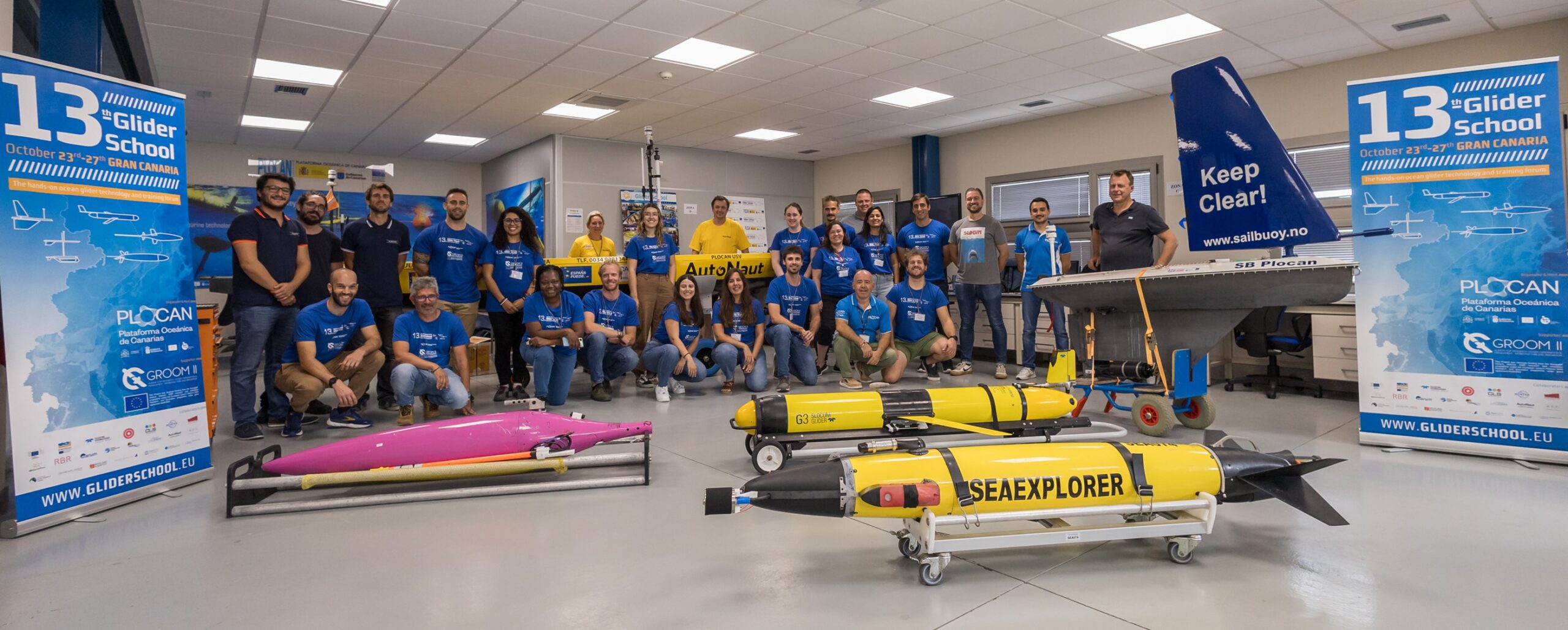
XIII PLOCAN Glider School
The Marine Autonomous Vehicles Area (VIMAS) of the Canary Islands Ocean Platform (PLOCAN) organized the 13th edition of the Glider School, an international initiative for the improvement of knowledge and development of marine autonomous vehicles and the consolidation of PLOCAN as gliderport infrastructure in the North of the Atlantic. Students from Nigeria (FUTA), Brazil (National

EuroGOOS Conference 2023
The Marine Institute of Ireland held the 10th EuroGOOS International Conference in Galway with the title “European Operational Oceanography for the Ocean we want – Addressing the UN Ocean Decade Challenges”, as Ocean Decade endorsed event. The event brought together over 160 participants for an in-person Conference covering all aspects of operational oceanography and its

The USV-Mission Atlantic unmanned vehicle arrives in the Canary Islands after completing a two-month scientific mission in Macaronesia
The Mission Atlantic’s USV-WaveGlider unmanned vehicle has been picked up by PLOCAN staff in waters of Taliarte after completing 1,200 nautical miles and 78 continuous days of scientific mission collecting 3D information on essential ocean variables (physical, chemical and biological), as well as map biodiversity and pressures in areas of special sensitivity in the North