The island of La Palma is hosting, until 23 September, the launch meeting of the European project ‘Isla Bonita’ (Supporting Managing Authorities to Restore the Oceans and Waters on Islands), an initiative funded by the European Union under the Horizon Europe Mission ‘Restore our Ocean and Waters by 2030’, bringing together representatives of the consortium’s 48 beneficiary entities from sixteen countries.
The CEO of the Oceanic Platform of the Canary Islands (PLOCAN), the project’s coordinating entity, José Joaquín Hernández, highlighted during the launch press conference that the project — which will run for sixty months, from September 2026 to August 2031 — is being led “from here, from the island of La Palma.”
“We are talking about a project worth almost €17 million, funded by the European Union with the participation of more than 15 countries, 51 institutions and nine European island regions from the Mediterranean and the Atlantic, working together to develop real solutions — solutions for each of these regions,” he explained.
For her part, the CEO of the Canary Islands Maritime Cluster, a partner entity that organised the project’s launch sessions, stated that the ‘Isla Bonita’ project “is a major European project that places the Canary Islands at the centre of ocean restoration, the energy transition and climate resilience.” “It is especially important that a project of this kind is coordinated from the Canary Islands, and that one of its main demonstrators is being developed on the island of La Palma,” she noted.
Elba Bueno noted that “technological solutions alone are not enough.” “For innovation to have a real impact on the territory, it has to involve businesses, public administrations, knowledge centres and the full range of actors who will make it possible for this innovation to take root and, above all, to be sustained over time,” she said.
“From the Canary Islands Maritime Cluster, we will help ensure that this demonstration is not just a technological project, but an experience built together with this territory. The Living Lab must serve to listen, to cross-check needs, to bring in knowledge and to generate connections between those developing the solutions, those who can apply them, those who use them, and even those who can bring them to market,” she explained.
Also speaking at the press conference was Freddy Medina, CEO of the local company ‘AcuiPalma’, which specialises in aquaculture, who highlighted the importance of research, innovation and development “in order to keep progressively improving and reach a better, more sustainable future for everyone.”
“This project is a very interesting and important opportunity for us, to be able to put research into practice, into the reality in which we work,” he noted.
The Councillor for the Environment of La Palma Island Council, Mónica Gómez Curiel, explained that the island “has a deep relationship with the sea.” “Our ocean is part of our identity, our economy and our territory. That is why the fact that our island is part of this European project, and that Tazacorte is part of it too, is an opportunity we will particularly value.”
“Isla Bonita is based on an idea we fully share: that the ocean must be an ally for our island community. As islands, we face very specific challenges, such as waste management, the energy transition, the protection of our marine ecosystems and the need to move towards a more sustainable blue economy. We know that these challenges cannot be tackled in isolation. We need cooperation, knowledge and, above all, we need solutions to be built together with those who live and work in our territories,” the Councillor stated.
Isla Bonita: living labs
Europe’s islands share the same challenges — energy dependency, complex waste management, degraded marine ecosystems and heavy tourism pressure — but they rarely have, on their own, the technical and financial capacity to address them. Isla Bonita starts from a different premise than usual: that change should be led by each island’s own managing authorities — island councils, municipal councils and regional governments — with the technical support of research centres and businesses.
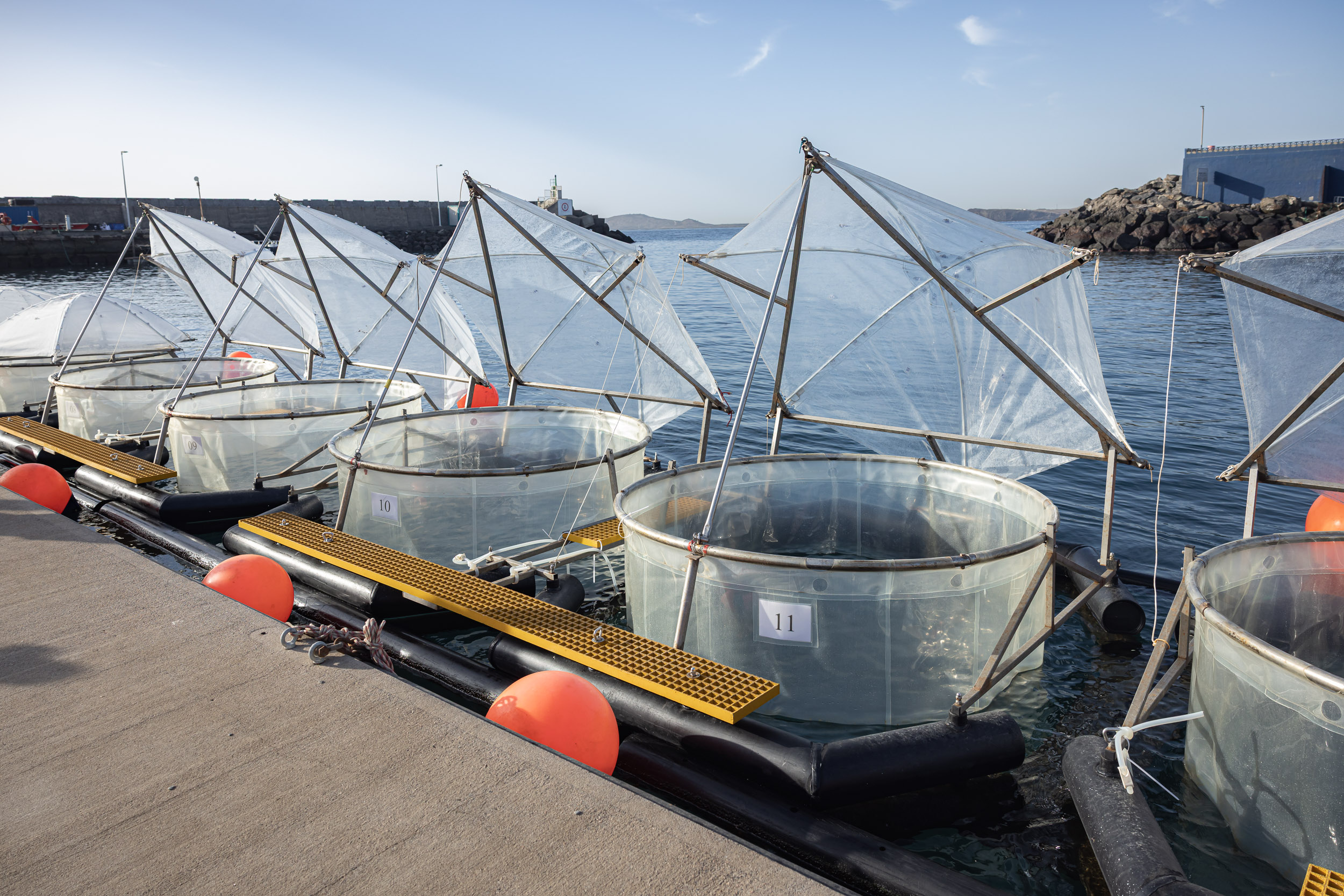
To this end, the project will set up nine Living Labs, one per demonstrator island, bringing together public administrations, fishers, businesses, the scientific community and citizens around the same table; it will deploy nine demonstrators in aquatic environments, based mainly on nature-based solutions and blue technology; and it will co-create a long-term roadmap for each island. It will also create a permanent Mission Ocean Accelerator Hub at PLOCAN’s facilities in Gran Canaria, together with specialised financial partners, so that these roadmaps attract real investment rather than remaining on paper. A replication strategy will make it possible to extend what works to many other European islands.
Nine islands, three basins
The demonstrators are grouped into three lighthouse basins. In the Atlantic and Macaronesia: La Palma (floating solar power), Guadeloupe (sargassum valorisation) and the Azores (technology for sustainable cetacean watching). In the Mediterranean: Ischia (restoration of cold-water coral reefs and a circular economy with the fisheries sector), Santorini (comprehensive waste management programme) and Malta (low-energy wastewater treatment). In the Baltic and North Sea: Orkney (oyster reef restoration and removal of lost fishing gear), Bornholm (fish habitats and coastal protection) and Gotland (restoration of the land-river-sea continuum).
The La Palma demonstrator will consist of a 309 kWp floating solar power installation in the Port of Tazacorte, led by the Norwegian company Ocean Sun, which will supply energy and desalinated water to an aquaculture facility, reducing its emissions.